
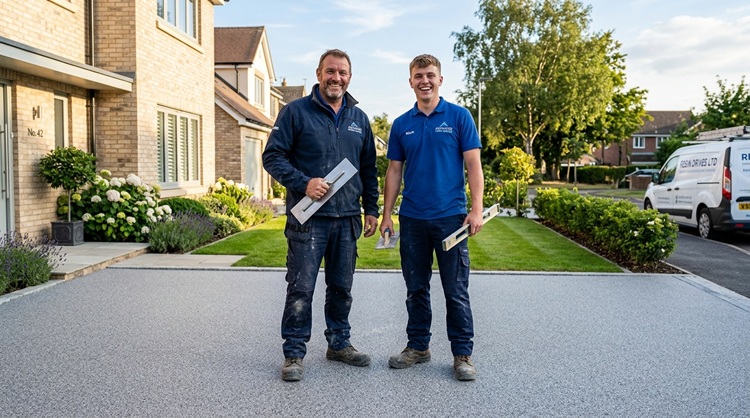

The approach to a house does more work than most people credit it for. It frames the front door, sets the colour temperature of everything around it and decides whether a frontage reads as considered or neglected. Good resin bound driveway ideas start with that relationship how the surface sits against brick, render, stone and planting rather than with a product specification. Get the blend and the edges right and the driveway recedes politely behind the house. Get them wrong and it dominates.
Resin Bound and Resin Bonded Are Not the Same Surface
Resin bound surfacing mixes aggregate through UV-stable polyurethane resin before laying, producing a smooth, permeable finish; resin bonded scatters loose stone across a resin-coated base and is not permeable.
That difference matters for both looks and rules. A bound surface is troweled flat, so it reads as a single continuous plane with a faint texture closer to a fine terrazzo than to gravel. A bonded surface keeps a rougher, scattered appearance and sheds loose stone over time.
Because the aggregate is fully encapsulated in a bound system, there are no joints for weeds to colonise. That is the practical advantage over jointed block paving, where weed growth and sand loss become a recurring spring job.
Start With the Aggregate Blend, Not the Brochure
The aggregate blend controls almost everything you will notice about the finished driveway, so choose it against your actual house colour rather than from a sample sheet indoors.
Aggregate is supplied in graded natural and recycled stone, and installers blend two or three colours to a set ratio. Small ratio changes shift the result more than people expect.
Warm Frontages: Buff, Golden Flint and Autumn Blends
Buff and golden flint blends suit red and orange stock brick, cream render and Portland-style stone detailing. They keep the frontage warm and hide light dust well.
On a bay-fronted inter-war semi with red brick and white timber, a buff-led blend with a small percentage of darker stone gives depth without turning the drive into a dark slab.
Cool and Contemporary: Charcoal, Silver and Grey
Charcoal and mid-grey blends work against grey aluminium windows, dark render, slate roofs and modern detached housing. They frame lighter walls sharply and make planting read greener.
The trade-off is heat and dust. Dark blends show pollen, salt residue and light debris more obviously than buff, which matters if you park under a tree.
What Coastal Weather Asks of a Driveway
Coastal frontages face two pressures at once: salt-laden air and long sunshine hours, and both act on the resin rather than the stone.
Lower-grade resins yellow under sustained UV exposure, which shifts a cool grey blend towards a muddy green-brown over several summers. UV-stable polyurethane resin is the specification to ask about anywhere with high exposure, and the south coast Bournemouth, Poole and Christchurch in particular gets a good deal of it.
Salt air affects the metalwork around a driveway more than the surface itself. Steel edging, gate ironmongery and drainage grates all deteriorate faster near the sea, so galvanised or aluminium alternatives are worth specifying at the same time.
Borders, Edges and Breaking Up a Large Expanse
A feature border is the cheapest way to stop a driveway looking like a car park, and it costs far less than changing the main blend.
A single course of contrasting block or a charcoal band around a buff field gives the surface a defined edge and visually shortens a long frontage. Some installers can set a contrasting inlay directly into the resin a border line, a house number, a simple geometric break.
Edges also do a structural job. Resin bound needs restraint at its perimeter, whether that is existing kerb, brick edging or an aluminium trim, or the margins will eventually break away.
Keep planting in the plan from the start. A gravel-free strip along the boundary, a raised bed or a run of clipped box softens the transition between hard surface and garden.
How Resin Bound Compares With Other Driveway Surfaces
No single surface wins on every measure resin bound leads on lifespan and drainage, block paving on repairability, tarmac on upfront cost.
| Surface | Typical lifespan | Maintenance | Drainage | Appearance | Indicative cost |
|---|---|---|---|---|---|
| Resin bound | 20–25 years | Low; no joints for weeds, occasional wash | Permeable | Smooth, continuous, colour-controlled | £100–£300 per m² |
| Block paving | 15–20 years | Moderate; jointing sand, weeding, occasional relay | Depends on block type and bedding | Modular pattern, strong texture | Varies by block and pattern |
| Tarmac | 10–15 years | Low, but edges and surface craze with age | Impermeable unless specified otherwise | Uniform, dark, utilitarian | Varies by area and access |
| Loose gravel | Depends on topping up | Frequent; raking, migration, topping up | Permeable | Informal, cottage-style | Varies by aggregate |
Costs are indicative and depend on aggregate choice, laying depth, access and how much groundwork the existing base needs.
Block paving keeps one genuine advantage: individual blocks can be lifted and replaced. A patch repair to a resin bound surface will usually be visible, because a new batch rarely matches a weathered one exactly.
Cost and Lifespan in Perspective
Resin bound typically carries a higher upfront cost than tarmac, and the case for it rests on lifespan and appearance rather than on being the cheap option.
Indicative UK pricing runs from around £100 to £300 per m². The spread reflects aggregate specification, resin depth and most significantly what lies underneath. A driveway laid over a sound existing base costs far less than one requiring full excavation and a new MOT Type 1 sub-base.
Against a 20–25 year expected life, the annual cost compares reasonably with block paving at 15–20 years or tarmac at 10–15. Treat all of those as planning figures, not promises; drainage, base quality and traffic load all move them.
How to Choose Someone to Lay It
Judge an installer on how they assess your existing base, not on how quickly they quote a price per square metre.
The base is where resin bound driveways fail. Ask what they intend to do about the existing surface, what depth of sub-base they consider adequate, and how they will handle drainage falls away from the house. A contractor who quotes without lifting a slab or checking levels is guessing.
Local knowledge earns its keep here. Someone working regularly on inter-war semis around Poole and Christchurch will already know how those older bases behave once opened up, and shortlisting local resin installers means you can have sample boards brought to your own frontage and viewed in natural daylight the only reliable way to judge a blend against your brickwork.
Ask to see recent work that has been down for a few years rather than photographs taken the week of completion. Weathering tells you more than a fresh trowel finish does.
Before Work Starts: Drainage, Permeability and Permissions
Permeable surfacing generally avoids the planning permission requirement that applies to new impermeable front driveways under sustainable drainage rules but the responsibility to check sits with you.
Under SuDS-related guidance, laying an impermeable surface over a certain area at the front of a property can require permission unless run-off is directed to a soakaway or permeable area within the boundary. A properly laid resin bound system on a permeable base drains through, which is why it usually falls within permitted development.
Usually is not always. Conservation areas, listed buildings and locations covered by an Article 4 direction can remove permitted development rights entirely, including for front boundary and surfacing work. Flats and maisonettes are treated differently from houses.
Check with your local council before committing BCP Council, for example, publishes guidance for the Bournemouth, Christchurch and Poole area, and every authority maintains its own. A five-minute enquiry is cheaper than lifting a finished driveway.
Frequently Asked Questions
Does a resin bound driveway get weeds?
The aggregate is fully encapsulated in resin, so there are no joints for seeds to settle into, unlike block paving. Windblown seed can occasionally root in surface debris, but a wash-down clears it. This is one of the clearer maintenance advantages over jointed surfaces.
Will the colour fade over time?
Natural aggregate holds its colour. The risk sits with the resin: lower-grade products yellow under UV exposure, which shifts the overall tone. Specifying UV-stable polyurethane resin addresses this, and it matters most on sunny, exposed frontages and where cooler grey blends have been chosen.
Can resin bound be laid over an existing driveway?
Sometimes, if the existing surface is sound, well drained and structurally stable. Overlaying a cracked or poorly draining base transfers those problems upwards. A competent installer will assess the base first and recommend excavation and a new MOT Type 1 sub-base where necessary.
How does the cost compare with block paving?
Both sit well above tarmac. Indicative resin bound pricing runs £100–£300 per m², with block paving varying by block type, pattern complexity and labour. Groundwork often costs more than the surface itself, so compare full quotations rather than headline square-metre rates.
Is resin bound slippery when wet?
The finish has a fine surface texture from the aggregate, and its permeability means water drains through rather than sitting on top. Anti-slip aggregate can be specified for steep or shaded areas. Discuss slope and shade with your installer at the design stage.
Bringing It Together
Treat the driveway as part of the front elevation rather than as a separate piece of groundwork. Choose the aggregate blend against your brickwork in daylight, plan a border before you plan the field, and settle drainage and permissions before anyone books a delivery. A surface that looks right on day one and still looks right after a decade of coastal weather comes from those decisions, not from the material alone.
