
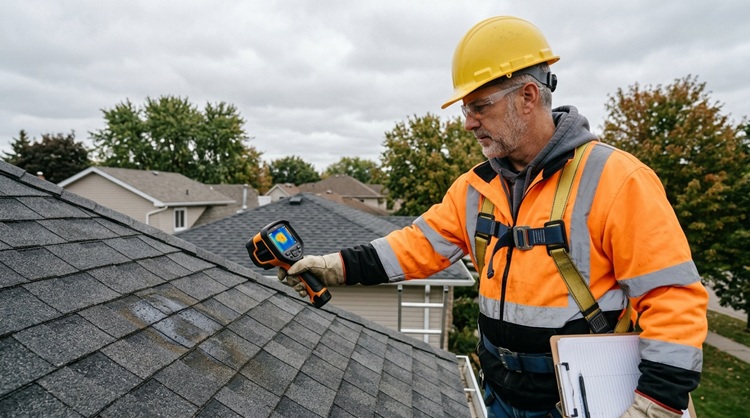

Fresh emulsion hides a ceiling stain for about three weeks. Then the mark returns, slightly larger, usually in the same corner.
Most interior finishes fail for a reason that has nothing to do with the paint. Roof damp problems sit behind a large share of ruined ceilings, blistered plaster and cold, musty box rooms, and no amount of sanding or sealing will hold if water is still getting in above. Working out what is happening at roof level first is the difference between decorating once and decorating every second spring.
Why Redecorating Over Damp Never Works
Paint and wallpaper are surface finishes. They cannot stop moisture, and applying them over an active leak traps water against the plaster, where it does more harm than the original stain.
There is a second problem. Water travelling through masonry carries dissolved salts, and those salts stay in the plaster after the surface dries. They draw moisture back out of the air, which is why a patch can look dry on a warm week and reappear the moment the weather turns.
Penetrating damp and condensation are not the same fault
Penetrating damp usually has a defined edge, a brown or yellow tidemark, and gets noticeably worse within a day or two of heavy rain. It tends to appear in one spot rather than across a whole room.
Condensation looks different: black speckled mould, often in corners, behind wardrobes, or along the top of external walls. It is worst on cold winter mornings and points to insulation and ventilation rather than a hole. Both can be traced upwards, but they need opposite remedies.
The Roof Faults Behind Most Roof Damp Problems
Six faults account for the majority of water entering a British home from above, and each produces a fairly predictable interior symptom.
| Roof fault | What you see indoors | Typical urgency |
|---|---|---|
| Cracked or lifted flashing at a chimney or abutment | Brown stain on the ceiling near a chimney breast | High — worsens with every storm |
| Slipped or broken slates and tiles | Isolated damp patch appearing after heavy rain | High |
| Loose or eroded ridge tiles | Staining along the line of the roof ridge upstairs | High on exposed elevations |
| Blocked or leaking guttering | Damp band on upper walls, green staining outside | Moderate, usually inexpensive |
| Rotten fascias and soffits | Flaking paint at the wall head, damp in top-floor corners | Moderate |
| Failed felt or EPDM on a flat roof or extension | Ceiling stain that spreads outwards, bubbling paint | High |
Flashing is the single most common culprit in older properties. It is the metal detailing that seals the joint between the roof covering and anything projecting through it, and because it moves with temperature it fatigues faster than the tiles around it.
How Long Roof Materials Actually Last
Indicative lifespans give you a sense of whether you are facing a repair or the beginning of a replacement. Treat these as broad ranges, since exposure, pitch and workmanship all shift the figures.
- Natural slate: 80–100 years or more, though the fixing nails often fail first
- Clay plain tiles: 60–100 years
- Concrete tiles: 40–60 years, with surface erosion visible earlier
- Lead flashing: 60 years plus if correctly dressed and not over-long in single pieces
- Mineral felt on a flat roof: 10–20 years
- EPDM rubber membrane: 20–30 years
- uPVC guttering: 20–30 years, assuming it is cleared twice a year
A pitched roof sheds water quickly and forgives small defects. A flat roof does not, which is why a rear extension or dormer is so often the source when the rest of the house is sound.
Period Homes, Conservation Areas and What You Can Change
On a listed building, or within a conservation area, you may not be free to change roof materials — and in some cases even a like-for-like repair needs consent, so check with your local authority before ordering anything.
This matters more than homeowners expect in the North West, where a great deal of the housing stock is Victorian or earlier and originally roofed in Welsh slate. Substituting concrete tiles onto a roof built for slate can also overload the timbers, since the two weigh very different amounts per square metre.
Owners of older Cheshire properties often shortlist Chester Roofers who have already worked on comparable terraces, because a contractor familiar with local sandstone detailing, reclaimed slate sourcing and the conservation rules inside the city walls will flag those constraints before scaffolding goes up rather than halfway through the job. Regional weather is part of the same calculation: prevailing westerly rain drives water sideways into joints that would stay dry on a sheltered elevation elsewhere in the country.
If a loft conversion is in your longer-term plans, raise it at the survey stage. Rafter depth, existing insulation and the condition of the covering all determine whether a conversion is straightforward or requires structural work you would rather know about now.
Getting the Timing Right
Book roof repairs for late spring or early summer, and schedule redecoration only once the affected plaster has properly dried out.
A common trade rule of thumb allows roughly a month of drying time per 25mm of wall or ceiling thickness after the source of water is fixed. Rushing this is how stains reappear through brand-new paint.
Once dry, seal the affected area with a stain-block primer before any topcoat, otherwise tannins and salts bleed straight through emulsion. On older solid walls, a breathable finish will cope better than a plastic-heavy modern paint.
Frequently Asked Questions
How do I tell a roof leak from a plumbing leak?
Roof leaks respond to weather; plumbing leaks do not. If the stain darkens within a day of heavy rain and stays stable during dry spells, suspect the roof. A constant, slowly growing patch under a bathroom or near pipework points to plumbing. Check the loft with a torch during rainfall.
Can I just repaint a stained ceiling and hope for the best?
Only if the source is confirmed fixed and the plaster is fully dry. Otherwise the mark returns within weeks, usually larger. Use a stain-block primer first, as emulsion alone will not seal water-borne salts or tannins from timber.
Do I need permission to replace my roof?
Like-for-like repairs are usually permitted development, but listed buildings and conservation areas are treated differently, and changing material or profile can require consent. Rules vary between authorities and individual designations, so confirm with your local planning department before committing to a specification.
Should I insulate the loft before or after roof repairs?
After. Insulating first risks burying a defect and soaking new material, which destroys its performance. Fix the covering, allow the structure to dry, then insulate — keeping eaves ventilation paths clear so warm moist air can escape rather than condensing on cold timbers.
Deciding What to Tackle First
The order matters more than the budget. Fix the water, allow the drying time, then spend on finishes.
Start with a proper look at flashings, ridge and guttering, since those three cause more interior damage than full roof failure ever does. Once the fabric is sound, the paint you choose will still look right in five years.
