

Consider an irony: Too much on display ultimately blurs the view. The truth is that the best homes are more about what not to do.
Yes, there is something deeply appealing about a home that truly feels like a haven without too much going on. The goal is not just to make a space look better. That’s something overstyling can also achieve. What you want is for your space to feel easier to live in and maintain.
As per recent data, 52% of homeowners had planned to renovate their homes in 2025, whereas 44% were planning to redecorate. While this sounds promising, a delicate balance must be maintained. Effort, if applied in the wrong direction, will make the home feel out of balance.
Thankfully, it is possible to create an effortlessly put-together home. This article will share four practical tips that will help you get that polished look without overcomplicating the process.
Strip Back the Excess Before Styling the Space
There is a thin line between enough and excess. Understanding where to draw that line is imperative for a home that feels put together. So, you cannot afford to style a space unless the excess has been driven out.
At this stage, it isn’t about neatly arranging stuff either. If your space is overloaded with items, used or unused, it will look tacky no matter how well arranged it is. The challenge is that much of this excess comes from the ‘in-between’ items, those that you don’t really use but do not wish to part with either. It’s best to move these out of your everyday environment to get a better view of the space.
Think of it this way. When people relocate and move homes, they don’t try to reorganize everything while it’s still in place. Most pack things up, move them out, and deal with them separately. As Redwood Moving & Storage notes, relocating to a new home is a big life change. It requires organization, efficiency, and in most cases, a team of support.
During this process, moving & storage solutions become essential, not just to transport belongings, but also to sort and store them properly later. You don’t have to be moving to apply the same principle. On a smaller scale, moving non-essential items out of the main living areas will reduce visual clutter. Focus on doing the following:
- Remove what hasn’t been used in the past three months. Not everything needs to stay in the main space all the time.
- Make sure all pathways and corners are free of clutter. Movement across the home should feel natural, not obstructed.
- Eliminate the stacking of items as far as possible. Too many items piled on top of each other increase both visual and physical clutter.
- Allow the room to breathe from a structural standpoint. In other words, consider open floor concepts to make the space feel lighter and more functional.
Work With What You Already Have
Since you are aiming for an effortlessly put together look for your home, it makes no sense for the eyes to work overtime. Buying new items will only invite chaos to one’s periphery of vision. What you need to do is to use what’s already there in a creative way.
A 2024 study has confirmed that visual clutter can reduce the efficiency of information flow to the brain. This means the brain will find it more challenging to process what the eyes see.
Does your room feel chaotic? Then, it’s not just in your head. Your mind could literally be trying to keep up. Stop thinking of ways to add more, and rearrange what’s already there in a smart way. Here are some strategies that will help:
- Group similar items together, like it means something. This would include those with the same colours, materials, and shapes to create visual continuity.
- Create one clear focal point in the room rather than scattering attention to multiple areas.
- Don’t throw in random colours and textures. Repeating one variation a few times helps create a smooth pattern for the eyes to follow.
- Refrain from having too many small objects on display. A few, well-placed pieces will feel more strategic and visually harmonious.
- Move things around a bit before you invest in something new. It’s possible that a new look can simply mean your old chair is placed in a better spot.
Any space that doesn’t let the viewer’s eyes do the heavy-lifting naturally ends up feeling calmer and more cohesive. In most cases, nothing new is needed.
Fix What’s Throwing a Room Off
Sometimes, a room looks perfectly fine, but still feels off. Such a disconnect may arise due to issues taking place beneath the surface, not the decor itself. In fact, it’s possible that the issues themselves are more than cosmetic.
Take water damage as an example. Disaster Masterz notes that while experiencing water damage, it is vital to act at the earliest to avoid further complications like mould growth. Such issues are far more common than many homeowners assume.
As per a 2024 report, water-related issues like leakages and burst pipes accounted for 28.63% of all home insurance claims in the same year. That makes it one of the leading causes of property damage. Beyond specific incidents, most homes deal with some form of disruption that builds over time, including:
- Lingering odours that don’t fully go away and affect how fresh a space feels, despite looking clean
- Worn-out or slightly damaged surfaces, such as minor stains or scuffed areas
- Dust and buildup in overlooked spots like corners, vents, and soft furnishings that don’t easily go with routine cleaning
- A general lack of freshness that happens when fabrics and materials haven’t been deeply refreshed
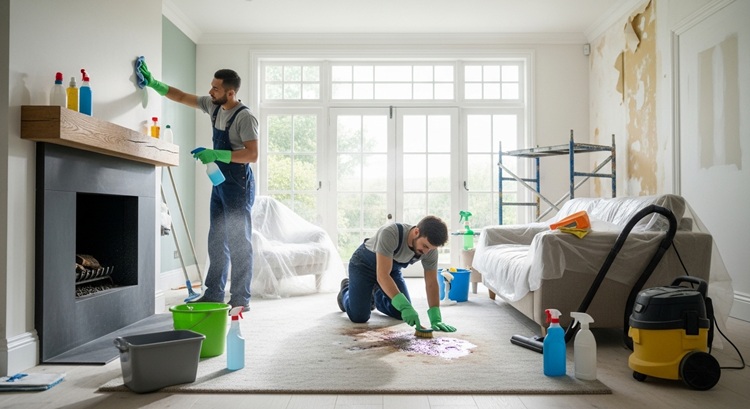
These underlying issues create a sort of background disturbance that styling alone cannot fix. In such cases, only deeper restoration & cleaning help bring back the space to its pristine state. Essentially, the home not only looks better but also feels finally put together.
Create a Sense of Balance With Small Touches
Unless a space possesses a quiet structure to it, it will not look effortlessly put together. Again, this will not happen by adding more decor, no matter how stellar they look. The key is to introduce a few timeless, consistent elements that hold the room together.
These touches would aim to guide the eye and give an intentional feel to the space rather than an accidental one. As per recent data by Houzz, 54% of homeowners undertook decorating projects in 2024. At least this confirms that wanting cohesion in a space is not uncommon.
Instead of filling every corner of a room, you can bring about visual balance simply by focusing on a few details that keep things grounded. In practice, that would look like the following:
- Stick to a tight colour palette, limiting the appeal to a maximum of three hues. This will ensure that nothing feels out of place or competing for attention.
- Maintain well-defined zones even if the space is modest. Clear separation between different areas, like seating or work, instantly adds a sense of purpose and organisation to a space.
- Produce visual stability through clean lines in the form of straightened rugs, aligned frames, and balanced spacing. This way, you won’t have to add anything new.
- Ensure the lighting is well-adjusted as per the needs of the space. If the warmth and intensity remain similar across light sources, you steer clear of a disjointed overall look.
- Don’t forget to include white or negative space wherever necessary. When certain areas are left undisturbed, they give the eyes a place to rest, thereby making the whole room feel composed.
The best part about these elements is that they work in the background. In other words, they can make your home feel put together without drawing attention to themselves.
A bold sofa or a statement wall art can become architectural focal points, but too much of such eye-catching stuff disturbs the harmony of a space. So, invest more in uniformity and structure than ornamentation.
If there is a golden rule you can follow, it is to resist the urge to do too much at once. Did you know that it is this one simple reason that most homes do not look effortlessly put together? Too many things on display and too many ideas competing for attention will land you in a bigger mess.
In case your current space feels overwhelming, take a deep breath and don’t try to change everything overnight, or even in a fortnight. Start small, say, pick one surface and declutter it properly. Similarly, you can have one nagging issue fixed, perhaps the one that demands the most urgent attention.
Baby steps will gradually help you reach your goal, whatever that may be, to make your home look put together. Just like that, things will fall into place without having to make a deal of anything in particular.
